
-
Design: Swing check valves feature a disc that swings on a hinge or pivot to open or close the valve. When the fluid flows in the intended direction, the disc swings open. When the flow direction reverses, the disc swings back to the closed position to prevent backflow.
Materials: Swing check valves are available in various materials to suit different applications:
Body Materials: Cast iron, carbon steel, stainless steel, and alloy steels.
Disc Materials: Stainless steel, bronze, or other corrosion-resistant materials.
Seat Materials: Elastomers (such as EPDM or NBR), or metal seats for higher temperature and pressure applications.
Pressure Rating: Swing check valves are available in various pressure ratings, typically specified by ANSI classes such as Class 150, 300, 600, etc., to match the requirements of different applications. Higher pressures on request.
Size Range: These valves come in a wide range of sizes to accommodate different pipeline diameters and flow requirements.
End Connections: Can be equipped with different end connections including flanged, threaded, or welded, depending on the piping system and application.
Swing Check Valve
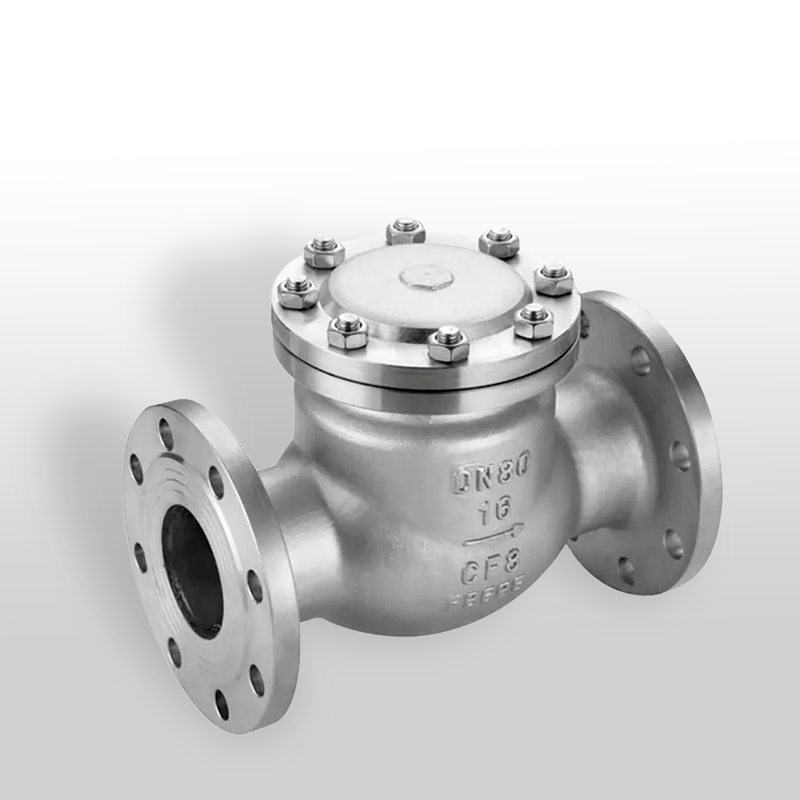
Swing Check Valve
An API standard swing check valve is a type of valve designed to prevent backflow in a piping system by allowing fluid to flow in only one direction. This is achieved through the use of a swinging disc that opens when fluid flows in the correct direction and closes to block reverse flow. Swing check valves are commonly used in various industrial applications to protect equipment and maintain system integrity.
General Description
Function: The primary function of a swing check valve is to prevent backflow or reverse flow in a pipeline. This is crucial for protecting pumps, compressors, and other equipment from potential damage caused by fluid flowing backward through the system.
Construction: Key components of a swing check valve include:
Disc (or Clapper): A hinged disc or clapper that swings open and closed to allow or block the flow of fluid. When the fluid flows in the correct direction, the disc swings open; when flow reverses, the disc swings closed to prevent backflow.
Body: The main part of the valve that contains the disc and other internal components. It is typically made from materials such as cast iron, carbon steel, stainless steel, or other alloys.
Hinge Pin: A pin or shaft on which the disc pivots to open or close the valve.
Seat: A sealing surface that provides a tight seal when the disc is closed, preventing leakage.
API Standards
API 6D/594/600:
-
Oil and Gas, Water and Wastewater, Chemical Processing, Power Generations.
-
Swing check valves operate automatically based on the direction of the fluid flow. The disc swings open with forward flow and closes with reverse flow. The valve’s design ensures minimal resistance to the forward flow.